
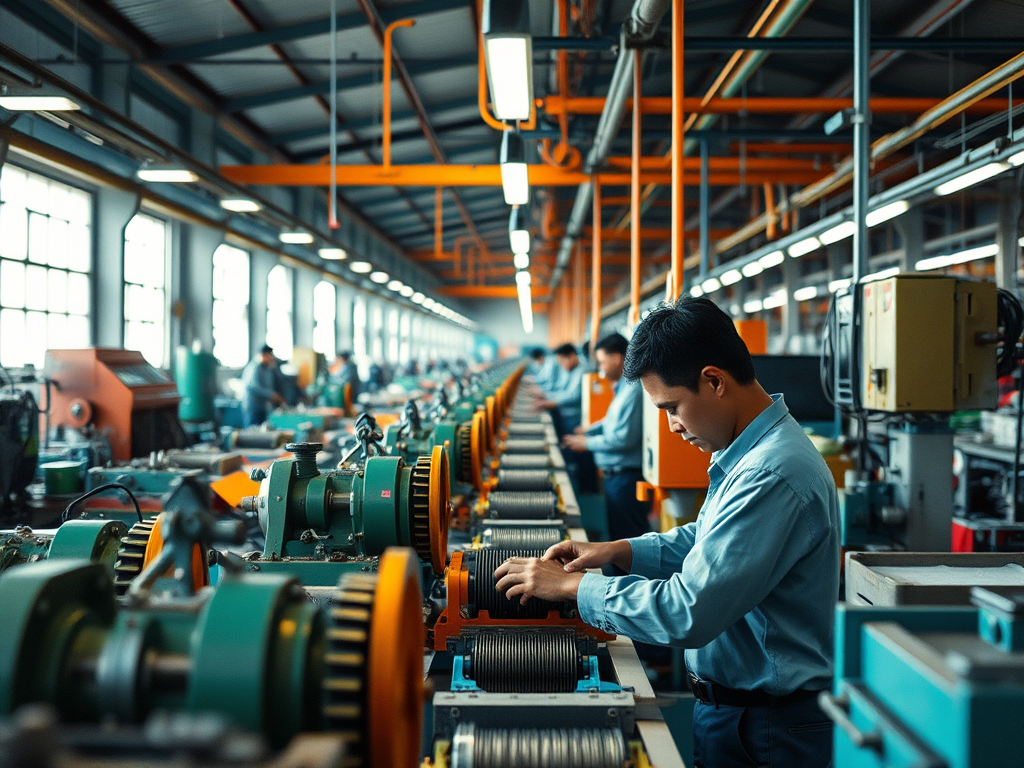
Despite the significant attention and priority given by the Party and State to developing the supporting industry, along with numerous investment incentives, there are still challenges and limitations in its progress. Supporting industries serve as the backbone of any major industry by providing essential parts, components, and technical processes. But what exactly is a supporting industry, and how does it impact Vietnam’s industrial landscape? This article delves into the concept, characteristics, and current state of Vietnam’s supporting industries, offering a clear picture of their critical role in the country’s economic growth.
What is a Supporting Industry?
Supporting industries encompass all industrial products that play a vital role in the production of main components. These include components, accessories, spare parts, packaging products, raw materials for painting, dyeing, and other intermediate products. In simpler terms, supporting industries are the unsung heroes that enable larger industries to function efficiently.
Classification of Supporting Industries
Supporting industries can be broadly classified into three major groups:
- Machinery and Equipment Providers: These industries supply machinery, tools, and equipment crucial for various sectors, including assembly, processing, and other supporting industries.
- Processing Industry Support: This group provides raw materials for processing industries like textiles and footwear. While these industries previously required minimal skilled labor, the advent of Industry 4.0 has raised the bar, demanding higher expertise to manage the evolving machinery and production scales.
- Assembly Industry Support: This group supplies components and spare parts for assembly industries, such as automotive, motorcycle, and electronics sectors. These industries require highly skilled workers, as their products—often metal, rubber, and plastic components—must meet stringent standards to ensure the quality of the final products.
In essence, supporting industries are indispensable for the development of national industries, especially in the era of global economic integration. A robust supporting industry reduces production costs, enhances product value, and boosts the competitiveness of the final product in the market.
Characteristics of Vietnam’s Supporting Industry
Vietnam boasts several strong industries, including garment manufacturing, footwear, and automotive and motorcycle assembly. However, despite these strengths, the domestic industry faces significant challenges.
Key Characteristics:
- Market Demand: The demand for supporting industries in Vietnam, particularly in sectors like automobile manufacturing, remains relatively small compared to the market’s potential.
- Technological Gap: There’s a noticeable quality gap between domestic suppliers and the demands of foreign direct investment (FDI) assemblers. Many raw materials required for production are still imported, as domestic production capabilities are limited. Additionally, the machinery used by local suppliers often lags in meeting the technological standards required for supporting industries.
- Human Resources: The expertise of workers in complex, high-skill-required products is limited. The industrial workforce remains undertrained, and there’s a disconnect between the production sector and training facilities.
- Information Channels: The link between domestic suppliers and assemblers is weak, with a lack of a centralized database to facilitate connections.
- Competitiveness: A significant portion of production incentives goes to foreign-invested enterprises, leaving domestic companies at a disadvantage. Moreover, the competitiveness of Vietnam’s supporting industries is still lower than that of neighboring countries, primarily because state-owned enterprises, which dominate this field, operate in a ‘from A to Z’ manner without fully embracing the concept of supporting industries.
Current Development Status of Vietnam’s Supporting Industries
Vietnam has over 500 enterprises producing metal components for downstream industries, yet they make up only a small fraction of the more than 7,000 mechanical enterprises in the country. These components primarily serve industries like motorcycle manufacturing, industrial and agricultural machinery, and automotive production.
Sector-Specific Insights:
- Automotive Support Industry: The mechanical components sector for automobiles and high-tech industries faces significant hurdles. Despite strengths in motorbikes and household mechanical engineering, domestic production only meets a small percentage of the demand for automotive components.
- Motorcycle Support Industry: This sector is relatively advanced, with high supply capacity due to strong market demand. Foreign direct investment (FDI) assembly enterprises have established cooperative relationships with local suppliers, boosting the industry’s growth.
- Textile and Garment Supporting Industry: Vietnam spends billions annually on importing raw materials like cotton and fabrics, mainly from China. Local development of the textile and garment supporting industry is hampered by environmental concerns, high investment costs, and limited resources among small and medium enterprises.
- Leather and Footwear Supporting Industry: Raw materials account for a significant portion of production costs, yet the localization rate is only about 40-45%. While there are around 130 enterprises producing raw materials, only a few can supply high-quality materials, making it difficult for manufacturers to manage orders and raw material sources efficiently.
The development of supporting industries in Vietnam has been a significant focus for the government, reflected in the issuance of Resolution No. 115/NQ-CP on August 6, 2020, which outlines solutions to promote the growth of these industries. The resolution sets specific goals, including the development of metal parts, plastic-rubber components, and electrical-electronic components, aiming to meet 45% of the domestic demand for these products by 2025. By 2030, this figure is expected to rise to 65%.
In the textile and garment, as well as leather and footwear sectors, the supporting industries are targeted to supply 65% of the textile industry’s raw materials and 75%-80% of the leather and footwear industry’s needs by 2025.
The government has prioritized the development of supporting industries, offering various investment incentives and fostering stronger linkages to solidify supply chains in key manufacturing sectors such as textiles, garments, footwear, and electronics. The production capacity of Vietnam’s supporting industries has gradually improved. Domestic enterprises can now supply certain plastic and rubber components for electronics, automobiles, and motorbikes, as well as aluminum and metal parts for automobiles, motorbikes, and machinery.
As a result of these advancements, the localization rate in several industries has increased, reducing reliance on imported components. Moreover, Vietnamese supporting industry enterprises are progressively enhancing their capabilities, producing high-tech, precision products that add significant value to the national economy.
 Lean Innovation Technology Co. Ltd.
Leave a comment