

Vietnam’s business climate has seen significant developments in recent years. Here are some key points:
- Foreign Direct Investment (FDI):
- Over the last two decades, FDI into Vietnam has grown at a double-digit rate.
- Vietnam is considered one of the most open countries in Asia regarding FDI receipts due to economic reforms and global integration.
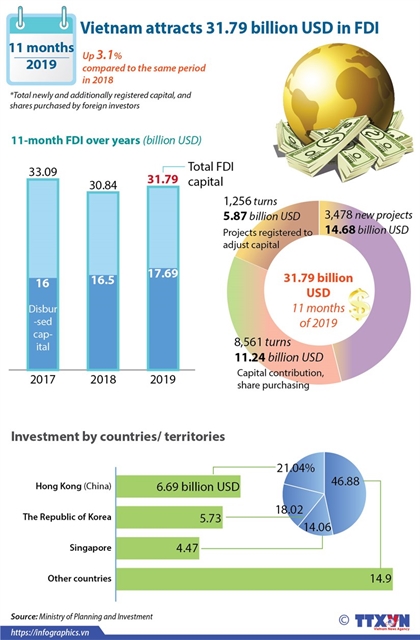
- In 11 months of 2019, Vietnam attracted USD 31.79 billion in FDI, with significant investments in manufacturing, electronics, textiles, footwear, and automobile parts industries.
- In Q1 2024, Vietnam showcased resilient economic growth with a GDP uptick of 5.66%, a significant stride since 2020. The manufacturing and services sectors were pivotal, surging by 6.28% and 6.12%, respectively. Foreign Direct Investment saw a 13.4% boost, securing an impressive US$6.17 billion, with the manufacturing and services sectors being pivotal. It is further noteworthy that Singapore and Hong Kong have reaffirmed their confidence in Vietnam’s growth story as leading investors.
- Reforms and Policies:
- The Vietnamese government has implemented ongoing economic reforms, new free trade agreements, and policies conducive to foreign investment.
- Resolution 55 aims to attract USD 50 billion of foreign investment by 2030 by amending regulations and emphasizing quality, efficiency, advanced technology, and environmental protection.
- The 2019 Securities Law and Labor Code provide flexibility for labor contracts and signal the government’s intention to remove foreign ownership limits.
- To stimulate FDI, Vietnam has rolled out new Decrees. Decree 32/2024/ND-CP provides investment incentives for industrial cluster development, particularly in disadvantaged areas, and supports entities constructing technical infrastructure. Concurrently, Decree No. 23/2024/ND-CP, aligned with the New Bidding Law, bolsters competitiveness and transparency in bidding through clear criteria, procedures, and requirements for investor selection and project implementation in specialized sectors.
- With regards to doing business in Vietnam, ESG (Environmental, Social, and Governance) considerations are increasingly becoming pivotal and aimed at driving business growth in tandem with sustainable development objectives. The latest Vietnam Business Forum (VBF) report offers fresh insights into ESG implementation, highlighting challenges and opportunities for enhancement from a business perspective.
- Challenges:
- Despite high FDI inflows (8% of GDP in 2019), challenges remain:
- Corruption
- Weak legal infrastructure and judicial system
- Poor enforcement of intellectual property rights
- Skilled labor shortages
- Restrictive labor practices
- Infrastructure impediments
- Slow decision-making process
- Despite high FDI inflows (8% of GDP in 2019), challenges remain:
- Global Competitiveness:
- Vietnam jumped 10 spots in the World Economic Forum’s 2019 Global Competitiveness Index.
- Continued reforms are recommended to simplify legal procedures and streamline bureaucratic decision-making.
- Climate Commitments:
- Vietnam is severely affected by climate change.
- The country has ambitious commitments, including a net-zero emissions target by 2050 and an end date for using coal.
- Swedish companies with sustainability profiles can contribute green solutions in response to Vietnam’s climate goals.
Overall, Vietnam’s business climate offers opportunities but also requires addressing challenges to create a favorable environment for investors and businesses.


Leave a Reply